

Body-Worn Cameras (BWC)
Overview
In late 2020, the Delta Police Department (DPD) became the first police department in British Columbia to operationally deploy BWCs across frontline operations.
BWCs are small video and audio recording devices worn on an officer’s uniform. They are one of several tools used by DPD to support effective policing, accountability and public confidence, in accordance with privacy legislation, provincial policing standards and departmental policy.
The program was implemented through a phased approach, with full frontline deployment completed in 2025 across Patrol, Traffic, Public Safety Operations and the Tsawwassen First Nation Service Team.
DPD currently uses a pooled deployment model with 60 cameras and has trained more than 110 frontline officers in their use. All DPD currently uses a pooled deployment model with 60 cameras and has trained more than 110 frontline officers in their use. Officers may only deploy a BWC after successfully completing DPD approved training and may also be required to complete periodic refresher training.
DPD community surveys have consistently shown strong support for BWCs, with well over 80% of respondents indicating that they expect frontline officers to wear them.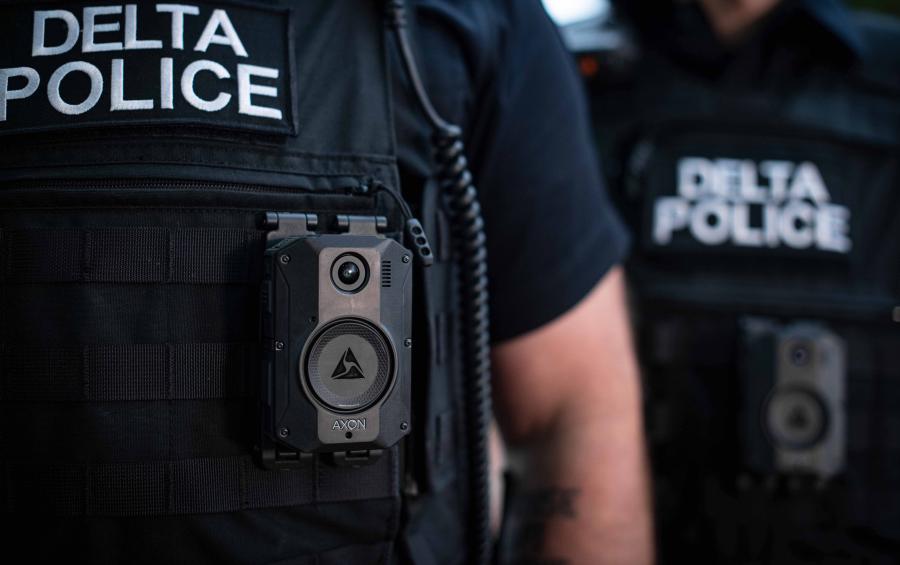
Why DPD Uses BWCs
BWCs support effective frontline policing by helping to:
- Enhance transparency, accountability and public confidence in policing
- Support officer safety and help de-escalate high-conflict situations
- Capture evidence for investigations and court proceedings
- Assist in the review and resolution of public complaints
- Provide real life examples to support officer training
When Do Officers Record?
BWCs are not used for continuous or indiscriminate recording.
Officers activate them in accordance with DPD Policy DP52 when carrying out law enforcement duties, including during investigations and interactions where a recording may assist with evidence, accountability or public safety.
Whenever reasonably possible and safe, an officer will advise people that a BWC is recording. The camera must also be worn in a location where it is readily visible.
Privacy and Responsible Use
DPD’s use of BWCs is governed by provincial policing standards, privacy legislation and Departmental Policy DP52. Recordings are securely stored, and access is restricted to authorized persons. Any access to or disclosure of BWC footage must follow approved processes and applicable policy requirements.
BWC recordings are automatically deleted after 13 months unless they are required for disclosure, evidence or training. Recordings associated with a file submitted for charge approval, or otherwise required for an evidentiary purpose, are retained for 40 years. Recordings retained for training may be kept for as long as they remain relevant as a training aid.
A Privacy Impact Assessment has also been completed for the BWC program.
Program Oversight and Audit
DPD conducts an annual review of the BWC program to assess compliance with provincial policing standards and DPD Policy DP52.
The 2025 BWC Program Update and Audit Report is available below.
Ongoing oversight helps ensure that BWCs are used appropriately and that the program continues to meet applicable standards, policy and privacy requirements.
Contact Us
Questions or concerns about the BWC program may be directed to DPD through the following channels:
-
E-mail: [email protected]
-
Phone: 604-946-4444